 ENGLISHCUE
Until 30 November: try EnglishCue PRO for US$0.99 your first week, then US$19.90/month, cancel anytime. Try PRO · US$0.99 →
Worksheet · B1 · For teachers and students · Free PDF, 3 pages
Passive Voice Worksheet with Answers
The passive puts the focus on the action or the result rather than on who did it: the bridge was built in 1890. Learners need it for work, news and processes. This sheet practises the passive in the main tenses, changing active sentences to passive, deciding when the agent with by is worth mentioning, and describing processes aloud.
Preview
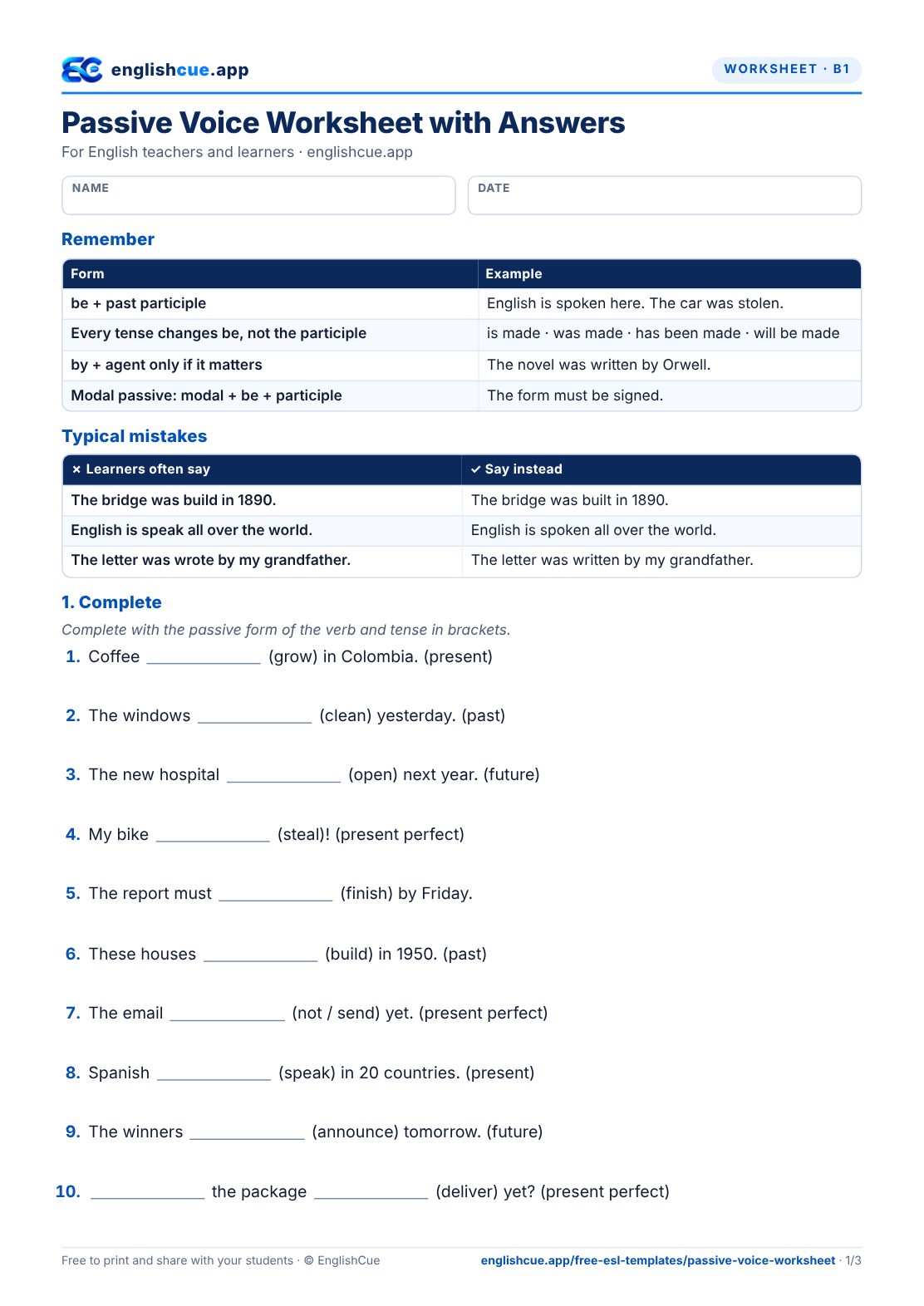
A4, portrait, 3 pages. No sign-up. Free to print, copy and share with your students.
How to use it
- Ask ‘Who did it? Do we know? Does it matter?’ before each transformation; if the answer is no, leave out by…
- Use a real process for the speaking task: how coffee is produced, how a product is made at the learner’s company.
- Give the first page in class or share it on screen; the last page ends with a model answer and the answer key, so print it separately or fold it back.
- Do the speaking questions last and spend at least ten minutes on them: the exercises prepare the language, the conversation is where learners own it.
What is on the sheet
The full content, so you can check it before you print or copy an example onto your own slide.
Remember
| Form | Example |
|---|---|
| be + past participle | English is spoken here. The car was stolen. |
| Every tense changes be, not the participle | is made · was made · has been made · will be made |
| by + agent only if it matters | The novel was written by Orwell. |
| Modal passive: modal + be + participle | The form must be signed. |
Typical mistakes
| ✗ Learners often say | ✓ Say instead |
|---|---|
| The bridge was build in 1890. | The bridge was built in 1890. |
| English is speak all over the world. | English is spoken all over the world. |
| The letter was wrote by my grandfather. | The letter was written by my grandfather. |
1. Complete
Complete with the passive form of the verb and tense in brackets.
- Coffee ___ (grow) in Colombia. (present)
- The windows ___ (clean) yesterday. (past)
- The new hospital ___ (open) next year. (future)
- My bike ___ (steal)! (present perfect)
- The report must ___ (finish) by Friday.
- These houses ___ (build) in 1950. (past)
- The email ___ (not / send) yet. (present perfect)
- Spanish ___ (speak) in 20 countries. (present)
- The winners ___ (announce) tomorrow. (future)
- ___ the package ___ (deliver) yet? (present perfect)
2. Rewrite
Rewrite in the passive. Use by only when it adds information.
- Someone cleans the office every day.
- Picasso painted Guernica.
- They will finish the road next month.
- Somebody has taken my coffee.
- You must wear a helmet.
- The company employs 500 people.
3. Correct the mistakes
Correct the mistake in each sentence.
- The museum was open in 1990.
- English is speak all over the world.
- My car has stolen.
- The letter was wrote by my grandfather.
- The results will announced tomorrow.
- This bridge built in 1900.
Writing
Describe a famous building, product or dish from your country in 6 sentences. Use at least four passive sentences (where it is made, when it was built, who it was designed by…).
Speaking
- Describe how something is made or done in your job, step by step, using the passive.
- What is your city known for? What is produced there?
- Talk about a famous building or work of art: when was it built or made, and by whom?
- What changes have been made in your company or school recently?
Show the answer key
1. Complete: 1 is grown · 2 were cleaned · 3 will be opened · 4 has been stolen · 5 be finished · 6 were built · 7 hasn’t been sent · 8 is spoken · 9 will be announced · 10 Has … been delivered
2. Rewrite: 1 The office is cleaned every day. · 2 Guernica was painted by Picasso. · 3 The road will be finished next month. · 4 My coffee has been taken. · 5 A helmet must be worn. · 6 500 people are employed by the company.
3. Correct the mistakes: 1 The museum was opened in 1990. · 2 English is spoken all over the world. · 3 My car has been stolen. · 4 The letter was written by my grandfather. · 5 The results will be announced tomorrow. · 6 This bridge was built in 1900.
Writing, model answer: The Obelisk is one of the most famous monuments in Buenos Aires. It was built in 1936 to celebrate the city’s 400th anniversary. It was designed by the architect Alberto Prebisch. It was finished in just over a month. Today it is visited by thousands of tourists every year, and it is used as a meeting point for big celebrations.
Use it with
More free worksheets
All 100 free worksheets by level, with a PDF pack per level →
Found this useful?
EnglishCue also has complete interactive lessons that open on screen, with audio, practice and speaking tasks.