ENGLISHCUE

Until 30 November: try EnglishCue PRO for US$0.99 your first week, then US$19.90/month, cancel anytime. Try PRO · US$0.99 →

B2 English grammar lesson · Modal verbs and the subjunctive · PRO · 60 min

Ability and possibility: could, managed to, was able to, succeeded in

I could swim at five. The storm was terrible, but we managed to reach the top. She succeeded in breaking the record.

The situation

Maya describes a climbing expedition: “As a teenager, I could climb almost anything. But on this mountain, the weather was terrible. After twelve hours, we managed to reach the summit, and I was able to take some amazing photos. Two other teams didn’t manage to get there.” By the end of this lesson you can describe abilities and achievements precisely.

Free practice worksheet

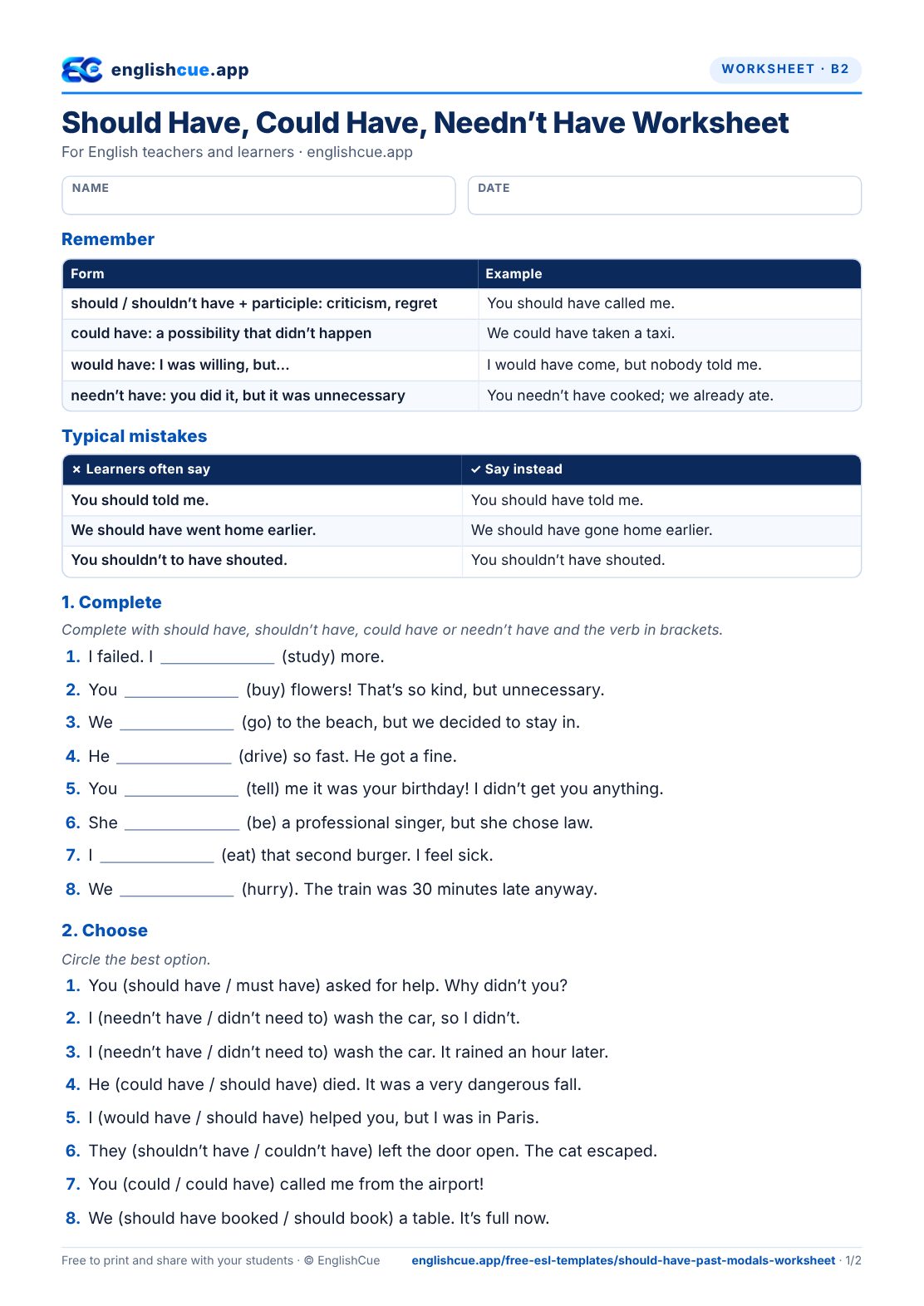
Should Have, Could Have, Needn’t Have Worksheet previewWorksheet · B2 · PDF with answersShould Have, Could Have, Needn’t Have Worksheet

The grammar at a glance

The forms your learner will use by the end of the lesson.

COULD

general past ability · senses

I could swim at five. I could hear music.

couldn’t = any situation

MANAGED TO / WAS ABLE TO

one success after difficulty

We managed to reach the summit.

not could

SUCCEEDED IN / FAILED TO

formal success / failure

She succeeded in breaking the record.

succeed in + -ing

BE ABLE TO

other tenses

I’ll be able to come. I’ve never been able to…

can has no future

Past ability

FormUseExample
could + base formgeneral ability over a periodAs a teenager, I could climb almost anything.
was / were able to + base formone specific success (or general)I was able to take some amazing photos.
managed to + base formone success after difficultyWe managed to reach the summit.
succeeded in + -ingformal: one successShe succeeded in breaking the record.

For one specific achievement, don’t use could: not “we could reach the summit after twelve hours”.

Common mistakes to watch for

The errors students make most often with this structure, and how to explain them.

  • After hours of trying, I could open the door. → After hours of trying, I managed to open the door.One success: managed to.
  • She succeeded to win the race. → She succeeded in winning the race.Succeed in + -ing.
  • I will can help you tomorrow. → I will be able to help you tomorrow.Future: be able to.
  • He managed opening the window. → He managed to open the window.Manage to + base form.
  • I have never could swim. → I have never been able to swim.Perfect: been able to.
  • We didn’t managed to finish. → We didn’t manage to finish.Didn’t + base form.

Teaching tips

Could with senses

With see, hear, smell, taste, feel, understand, remember, use could even for one occasion: “I could hear music from the street.”

Next lesson

Formal reporting: passive reporting (It is said that…, He is believed to…).

Quick check: three sample questions

Use them as a warm-up or an exit ticket. Answers are below.

  1. When I was young, I ___ run very fast.
    • could
    • managed to
    • succeeded in
  2. The exam was hard, but I ___ pass.
    • managed to
    • could
    • succeeded to
  3. After years of research, they succeeded ___ a cure.
    • in finding
    • to find
    • find
Show answers
  1. could. General ability.
  2. managed to. One success.
  3. in finding. Succeed in + -ing.

What the full lesson includes

  • A scene that shows the structure in use, with guided discovery questions.
  • Forms and examples on screen, with colour-coded contrasts.
  • Self-correcting practice: choose, fix, build and rewrite, with an explanation for every answer.
  • A recorded listening with transcript, a speaking task with follow-up questions and a short writing task with a model answer.
  • Teacher mode and self-study mode, so students can review after class.

Where this lesson fits in the course

More modal verbs and the subjunctive lessons

  1. B2Modals of deduction in the past: must have, might have, can’t haveSomeone must have eaten it. It can’t have been Tom. It might have been the cleaner.
  2. B2Should have, could have, needn’t have, didn’t need toYou should have told me! I needn’t have cooked so much. We didn’t need to book a table.
  3. B2Hedging and speculating: tend to, seem to, be likely toPeople tend to sleep less. It seems to work. Prices are likely to rise. Apparently, it’s safe.
  4. C1The subjunctive and unreal past: I suggest he go, If only I knewIt’s vital that she be informed. They insisted that he not leave. If only I had more time.

All modal verbs and the subjunctive lessons → All B2 grammar lessons →

Teach it and practise it

Teach this lesson with EnglishCue PRO.

Share your screen and teach: everything from the warm-up to the writing task is ready.