TEND / SEEM / APPEAR
+ to + base · seem to have + pp
It seems to have worked.
general / not sure ENGLISHCUE
Until 30 November: try EnglishCue PRO for US$0.99 your first week, then US$19.90/month, cancel anytime. Try PRO · US$0.99 →
B2 English grammar lesson · Modal verbs and the subjunctive · PRO · 60 min
People tend to sleep less. It seems to work. Prices are likely to rise. Apparently, it’s safe.
A science magazine writes: “Teenagers tend to go to bed late. Screens seem to affect their sleep. Schools that start later are likely to see better results. Apparently, some schools have already changed. However, it seems that more research is needed.” Scientists rarely say “This is true.” By the end of this lesson you can give opinions and predictions carefully, like in academic and professional English.
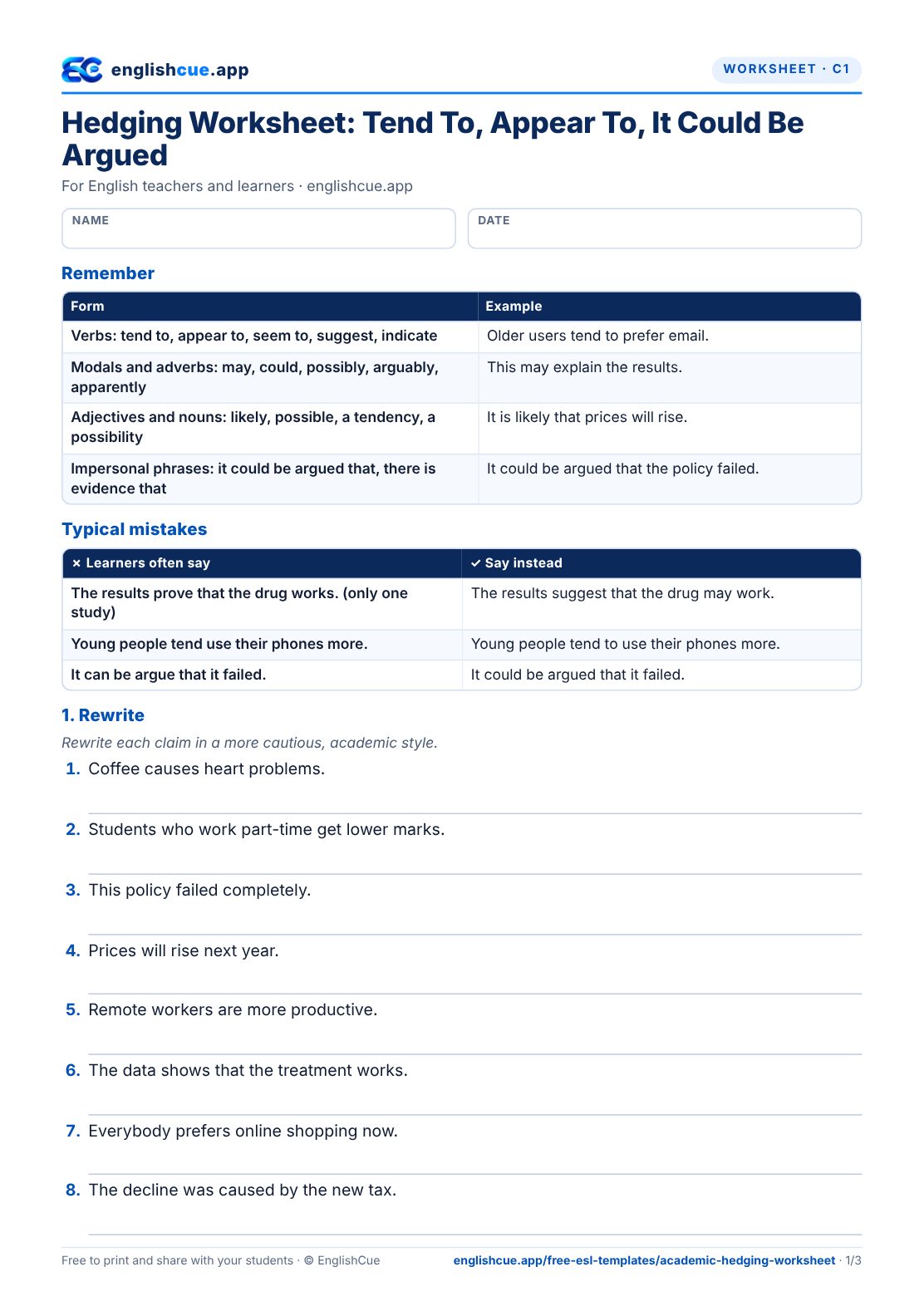 Worksheet · C1 · PDF with answersHedging Worksheet: Tend To, Appear To, It Could Be Argued
The forms your learner will use by the end of the lesson.
+ to + base · seem to have + pp
It seems to have worked.
general / not surebe (un)likely to · be bound to
Prices are likely to rise.
probabilityit seems that · there’s a chance that
It appears that…
objectiveapparently · to some extent · may / might
Apparently, it’s closed.
careful tone| Structure | Meaning | Example |
|---|---|---|
| tend to + base | usually, in general | Teenagers tend to go to bed late. |
| seem / appear to + base | it looks like (not 100% sure) | Screens seem to affect sleep. |
| seem to have + past participle | about the past | The plan seems to have worked. |
| be likely / unlikely to + base | probable / not probable | Prices are likely to rise. |
| be bound to / be sure to | almost certain | It’s bound to rain at the weekend. |
| it seems / appears that … | impersonal | It seems that more research is needed. |
| there’s a (good) chance that … | possible / probable | There’s a good chance that it will work. |
| apparently / presumably / to some extent | I heard / I suppose / partly | Apparently, the school changed its timetable. |
Likely is an adjective: be likely to. Probably is an adverb: will probably. ✗ It will likely… is common in AmE but avoid it in exams.
The errors students make most often with this structure, and how to explain them.
Preposition stranding: Who are you talking to? The flat I live in…
Use them as a warm-up or an exit ticket. Answers are below.
All modal verbs and the subjunctive lessons → All B2 grammar lessons →
Share your screen and teach: everything from the warm-up to the writing task is ready.