WILL
present habit · annoying WILL · assumption
That’ll be Tom.
character ENGLISHCUE
Until 30 November: try EnglishCue PRO for US$0.99 your first week, then US$19.90/month, cancel anytime. Try PRO · US$0.99 →
C1 English grammar lesson · Modal verbs and the subjunctive · PRO · 60 min
She’ll sit for hours reading. My grandad would tell us stories. He WILL leave his socks everywhere!
Amy describes her family: “My mum will sit for hours in the garden with a book. My brother WILL leave his shoes in the hall, which drives me crazy! When we were kids, my grandad would take us fishing every Sunday. He wouldn’t let anyone else drive his old car. Now, at family dinners, Mum asks: ‘Shall I make my famous pie?’” By the end of this lesson you can describe habits and character with will and would.
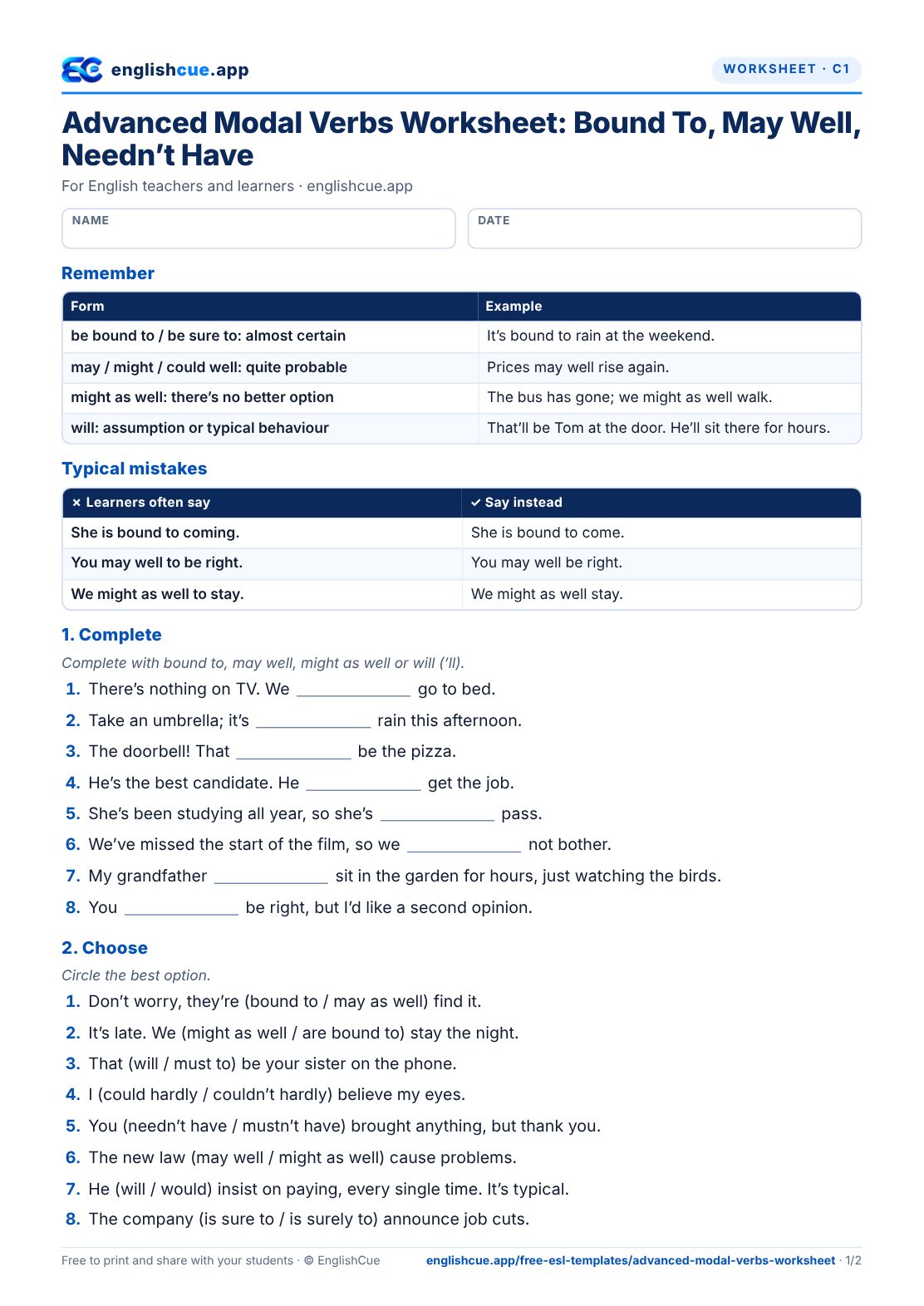 Worksheet · C1 · PDF with answersAdvanced Modal Verbs Worksheet: Bound To, May Well, Needn’t Have
The forms your learner will use by the end of the lesson.
present habit · annoying WILL · assumption
That’ll be Tom.
characterpast habit (actions) · WOULD = typical
Grandad would take us fishing.
states: used torefusal (people and objects)
The car won’t start.
present / pastShall I / we…? · formal rules
Shall I help you?
offers| Use | Form | Example |
|---|---|---|
| present habit / typical behaviour | will (’ll) + base | She’ll sit for hours reading. |
| annoying habit | stressed WILL + base | He WILL leave his shoes everywhere! |
| assumption about now | will + base / will be + -ing | The doorbell! That’ll be the pizza. |
| past habit (actions only) | would (’d) + base | Grandad would take us fishing. |
| criticism: typical of you | stressed WOULD | “It wasn’t me!” “You WOULD say that.” |
| refusal | won’t / wouldn’t + base | The car won’t start. · He wouldn’t listen. |
| offers and suggestions | Shall I / we + base? | Shall I make some tea? · Shall we go? |
| formal rules / contracts | shall + base | The tenant shall pay the rent monthly. |
Would for past habits works only with actions. For states (live, have, be, like, know), use used to: I used to live in Rome (✗ I would live in Rome).
The errors students make most often with this structure, and how to explain them.
Degrees of certainty: bound to, liable to, may well, could well, can’t have.
Use them as a warm-up or an exit ticket. Answers are below.
All modal verbs and the subjunctive lessons → All C1 grammar lessons →
Share your screen and teach: everything from the warm-up to the writing task is ready.