VERB + THAT
suggest / recommend / insist + that + base
I suggest that he go.
BrE: should go ENGLISHCUE
Until 30 November: try EnglishCue PRO for US$0.99 your first week, then US$19.90/month, cancel anytime. Try PRO · US$0.99 →
C1 English grammar lesson · Modal verbs and the subjunctive · PRO · 60 min
It’s vital that she be informed. They insisted that he not leave. If only I had more time.
A CEO sends a memo: “I recommend that every employee take a break every two hours. It is essential that the office be locked at night. The board insisted that no one work at weekends. If only we had more space!” The verbs look wrong (take, be, work), but they are correct: this is the subjunctive. By the end of this lesson you can use formal subjunctive and unreal past forms with confidence.
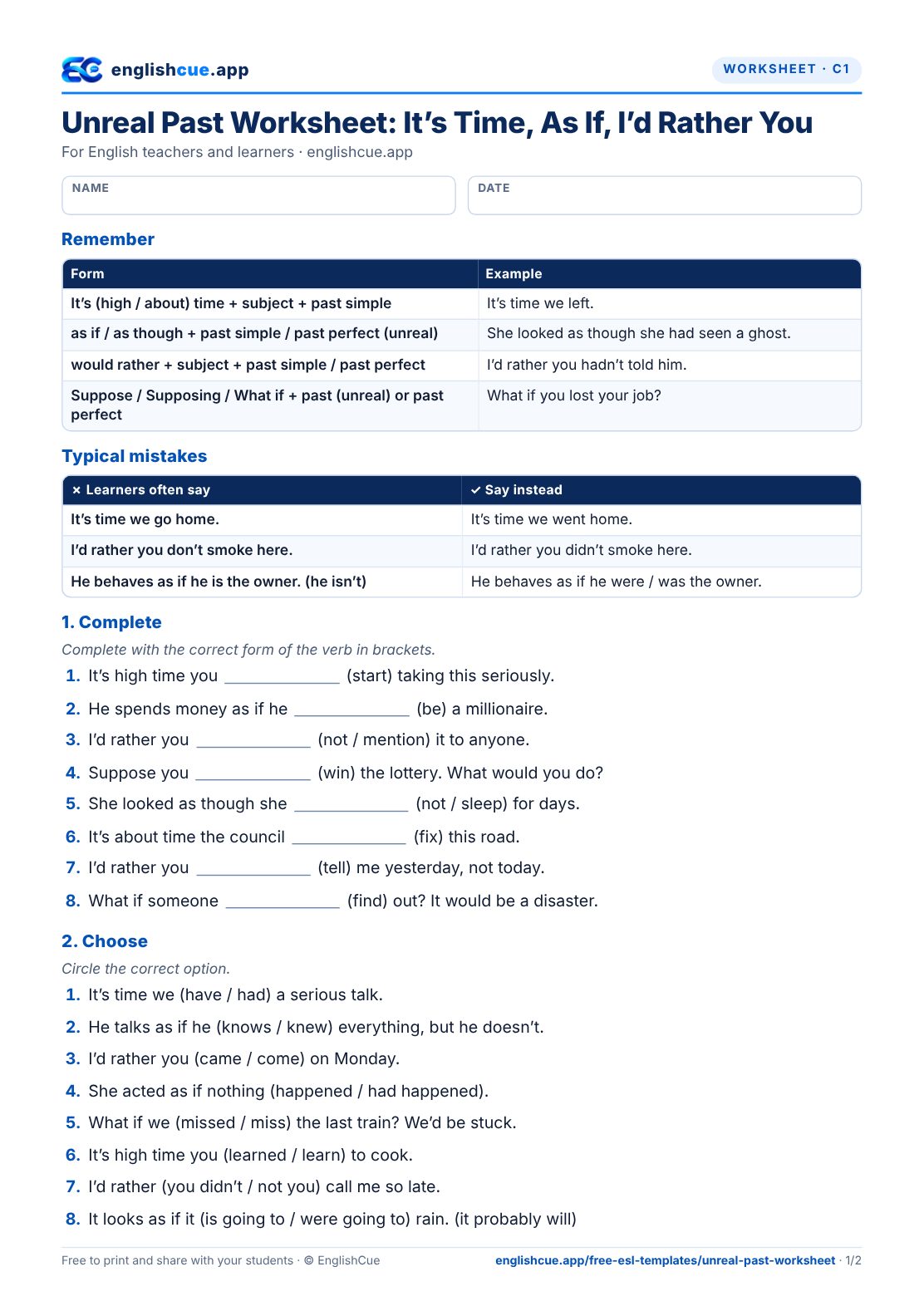 Worksheet · C1 · PDF with answersUnreal Past Worksheet: It’s Time, As If, I’d Rather You
The forms your learner will use by the end of the lesson.
suggest / recommend / insist + that + base
I suggest that he go.
BrE: should goessential / vital / important + that + base
It’s vital that she be told.
not + basewish / if only / as if + past / past perfect
If only I had known.
present vs pastbe that as it may · so be it
Be that as it may, …
formal| Structure | Form | Example |
|---|---|---|
| suggest / recommend / insist / demand / propose / request + that | subject + base form (all persons) | I recommend that he take a break. |
| it is essential / vital / important / crucial + that | subject + base form | It’s vital that she be informed. |
| negative | subject + not + base form | They insisted that he not leave. |
| BrE alternative | that + should + base | I suggest that he should go. |
| wish / if only + past | present wish | If only I had more time. |
| wish / if only + past perfect | past regret | I wish I had listened. |
| as if / as though + past | unreal comparison | He talks as if he were the boss. |
| fixed phrases | old subjunctive | Be that as it may, … · So be it. |
The subjunctive is mainly formal and written (and very common in American English). In everyday British English, people often use should or the normal present.
The errors students make most often with this structure, and how to explain them.
Modal nuance: will for habits, would for typical past behaviour, shall for offers and formal rules.
Use them as a warm-up or an exit ticket. Answers are below.
All modal verbs and the subjunctive lessons → All C1 grammar lessons →
Share your screen and teach: everything from the warm-up to the writing task is ready.