Until 30 November: try EnglishCue PRO for US$0.99 your first week, then US$19.90/month, cancel anytime. Try PRO · US$0.99 →
ENGLISHCUE English grammar lessons B2 grammar Modals of deduction in the past: must have, might have, can’t have B2 English grammar lesson · Modal verbs and the subjunctive · PRO · 60 min
Modals of deduction in the past: must have, might have, can’t have Someone must have eaten it. It can’t have been Tom. It might have been the cleaner.
The situation At the office, a birthday cake has disappeared from the kitchen. Sara: “Someone must have eaten it. Look, there are crumbs on the floor!” Mike: “It can’t have been Tom: he’s on holiday.” Sara: “It might have been the cleaner…” By the end of this lesson you can make deductions about the past .
The grammar at a glance The forms your learner will use by the end of the lesson.
MUST HAVE I’m sure it happened
Someone must have eaten it.
strong evidence MIGHT / MAY / COULD HAVE possibly happened
It might have been the cleaner.
might not have = possibly not CAN’T / COULDN’T HAVE I’m sure it didn’t happen
It can’t have been Tom.
not mustn’t have FORM modal + have + participle · have been + -ing
He must have been sleeping.
always have Past deduction Certainty Form Example almost 100% · I’m sure it happened must have + participle Someone must have eaten it. possible might / may / could have + participle It might have been the cleaner. possibly not might not / may not have + participle He might not have seen the message. almost 0% · I’m sure it didn’t happen can’t / couldn’t have + participle It can’t have been Tom.
Common mistakes to watch for The errors students make most often with this structure, and how to explain them.
He must went home early. He must have gone home early. Modal + have + participle. She mustn’t have heard me. (I’m sure she didn’t) She can’t have heard me. Negative deduction: can’t have. They might have came yesterday. They might have come yesterday. Participle: come. It must be raining last night. It must have been raining last night. Past: have been. You can’t have see him. He’s in Spain. You can’t have seen him. He’s in Spain. Participle: seen. He could has forgotten. He could have forgotten. Always have (not has). Teaching tips Must have → can’t have The opposite of must have is can’t / couldn’t have (not “mustn’t have”).
Next lesson Criticism and regret: should have, could have, needn’t have, didn’t need to .
Quick check: three sample questions Use them as a warm-up or an exit ticket. Answers are below.
The ground is wet. It ___ in the night. must have rained must rain must rained She ___ the email. She was on a plane all day. can’t have read mustn’t have read can’t read I’m not sure why he’s late. He ___ the bus. might have missed must have miss can’t have missed Show answers must have rained . Sure, past. can’t have read . Sure it didn’t happen. might have missed . Possible. What the full lesson includes A scene that shows the structure in use, with guided discovery questions. Forms and examples on screen, with colour-coded contrasts. Self-correcting practice: choose, fix, build and rewrite, with an explanation for every answer. A recorded listening with transcript, a speaking task with follow-up questions and a short writing task with a model answer. Teacher mode and self-study mode, so students can review after class. Where this lesson fits in the course More modal verbs and the subjunctive lessons B2 Should have, could have, needn’t have, didn’t need toYou should have told me! I needn’t have cooked so much. We didn’t need to book a table. B2 Ability and possibility: could, managed to, was able to, succeeded inI could swim at five. The storm was terrible, but we managed to reach the top. She succeeded in breaking the record. B2 Hedging and speculating: tend to, seem to, be likely toPeople tend to sleep less. It seems to work. Prices are likely to rise. Apparently, it’s safe. C1 The subjunctive and unreal past: I suggest he go, If only I knewIt’s vital that she be informed. They insisted that he not leave. If only I had more time. Teach this lesson with EnglishCue PRO. Share your screen and teach: everything from the warm-up to the writing task is ready.
 ENGLISHCUE
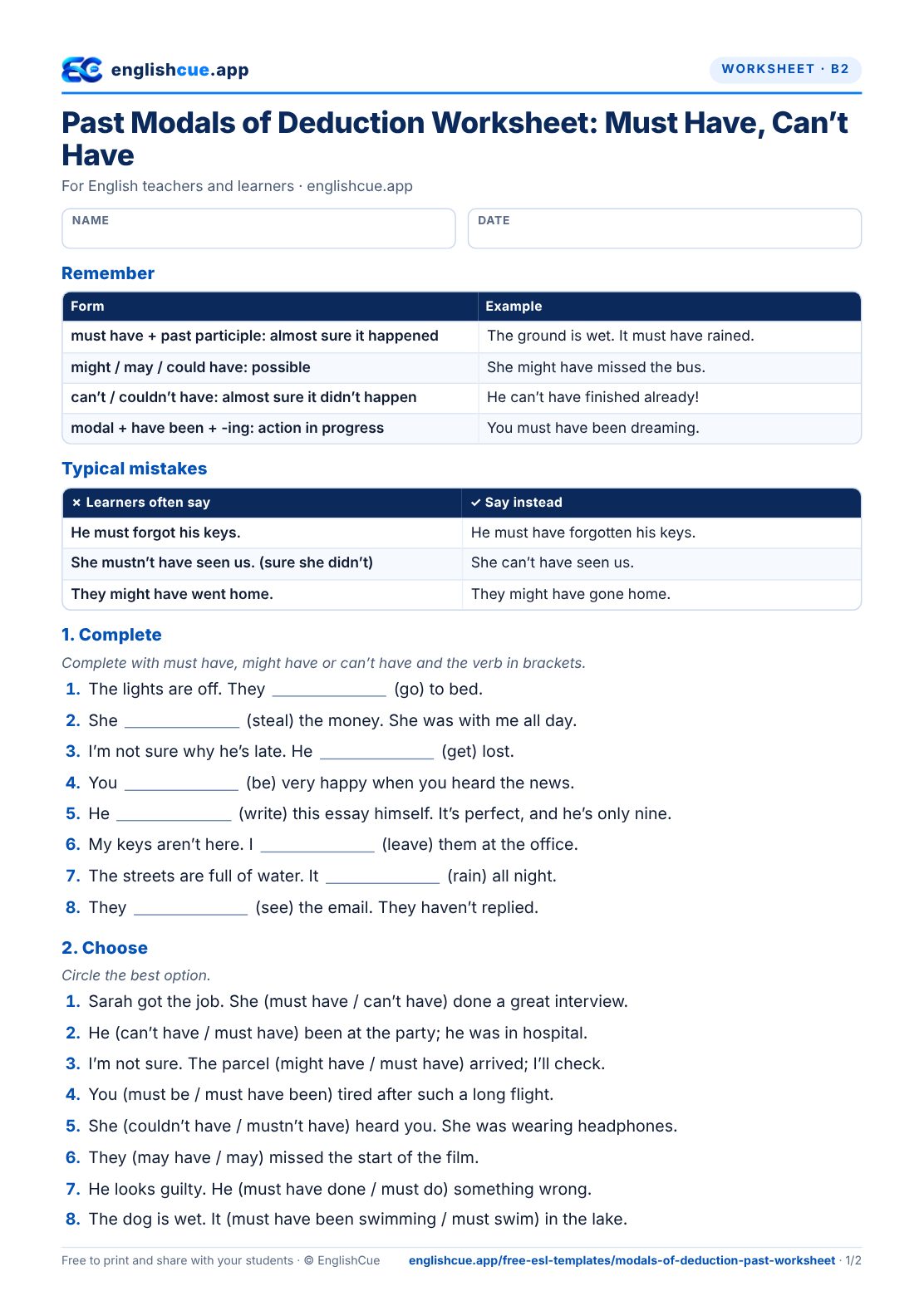 Worksheet · B2 · PDF with answersPast Modals of Deduction Worksheet: Must Have, Can’t Have