OBLIGATION
must · have to · be supposed to · be required to
We’re supposed to recycle.
often not done ENGLISHCUE
Until 30 November: try EnglishCue PRO for US$0.99 your first week, then US$19.90/month, cancel anytime. Try PRO · US$0.99 →
C2 English grammar lesson · Modal verbs and the subjunctive · PRO · 60 min
You needn’t have brought anything. We’re supposed to wear ties. You might have told me! She won’t listen.
At a dinner party: “Oh, you needn’t have brought wine — we have plenty!” (they brought it; it wasn’t necessary). Later: “We’re supposed to take our shoes off here.” (that’s the rule… but people often forget). The next day, to a friend: “You might have told me it was formal!” (annoyed). And about a guest: “He won’t stop talking about his car.” (refuses / insists). By the end of this lesson you can express subtle shades of obligation, willingness, criticism and likelihood.
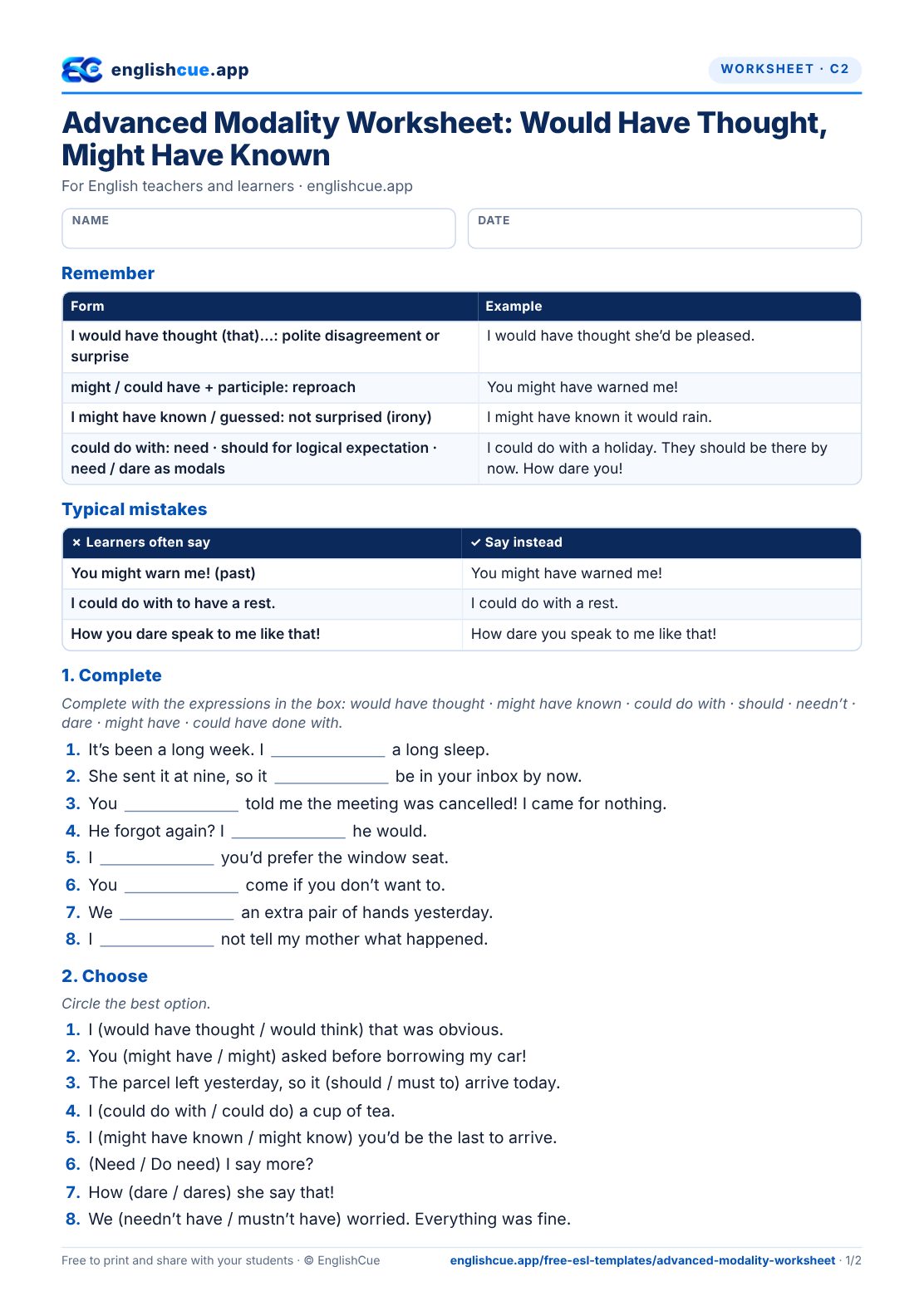 Worksheet · C2 · PDF with answersAdvanced Modality Worksheet: Would Have Thought, Might Have Known
The forms your learner will use by the end of the lesson.
must · have to · be supposed to · be required to
We’re supposed to recycle.
often not doneneedn’t have + pp (done) · didn’t need to (not done)
You needn’t have brought wine.
key C2 contrastwill / won’t · WILL · be reluctant to
The car won’t start.
refusalmight / could have + pp · can’t possibly · bound to
You might have told me!
attitude| Meaning | Forms | Example |
|---|---|---|
| obligation: speaker vs external | must (I decide) · have to (rule / situation) | I must call Mum. · I have to wear a uniform. |
| expected but often not done | be supposed to | We’re supposed to recycle, but nobody does. |
| did it, but unnecessary | needn’t have + pp | You needn’t have brought wine. |
| not necessary (probably not done) | didn’t need to + base | I didn’t need to pay. It was free. |
| willingness / refusal | will / won’t · be willing / reluctant to · would rather | The door won’t open. · I’m reluctant to agree. |
| annoyed criticism (past) | might / could have + pp | You might have told me! |
| strong likelihood | be bound to · can’t possibly · may well | It can’t possibly be true. |
Needn’t have vs didn’t need to is a classic C2 distinction: the first means the action happened unnecessarily.
The errors students make most often with this structure, and how to explain them.
Formulaic subjunctive and fixed expressions: be that as it may, suffice it to say, come what may.
Use them as a warm-up or an exit ticket. Answers are below.
All modal verbs and the subjunctive lessons → All C2 grammar lessons →
Share your screen and teach: everything from the warm-up to the writing task is ready.