CONTRAST / ACCEPTANCE
be that as it may · so be it
Be that as it may, we must decide.
formal ENGLISHCUE
Until 30 November: try EnglishCue PRO for US$0.99 your first week, then US$19.90/month, cancel anytime. Try PRO · US$0.99 →
C2 English grammar lesson · Modal verbs and the subjunctive · PRO · 60 min
Be that as it may, we must decide. Come what may, I’ll be there. Suffice it to say, it was a disaster.
A director gives a retirement speech: “Forty years ago, Margaret joined us as a junior clerk. Suffice it to say, she did not stay junior for long. Some say she was too strict. Be that as it may, she made this company what it is. Far be it from me to tell her how to enjoy her retirement, but I hope she finally takes a holiday. And come what may, she will always be part of this family.” These are fixed subjunctive formulas. By the end of this lesson you can understand and use them with the right tone.
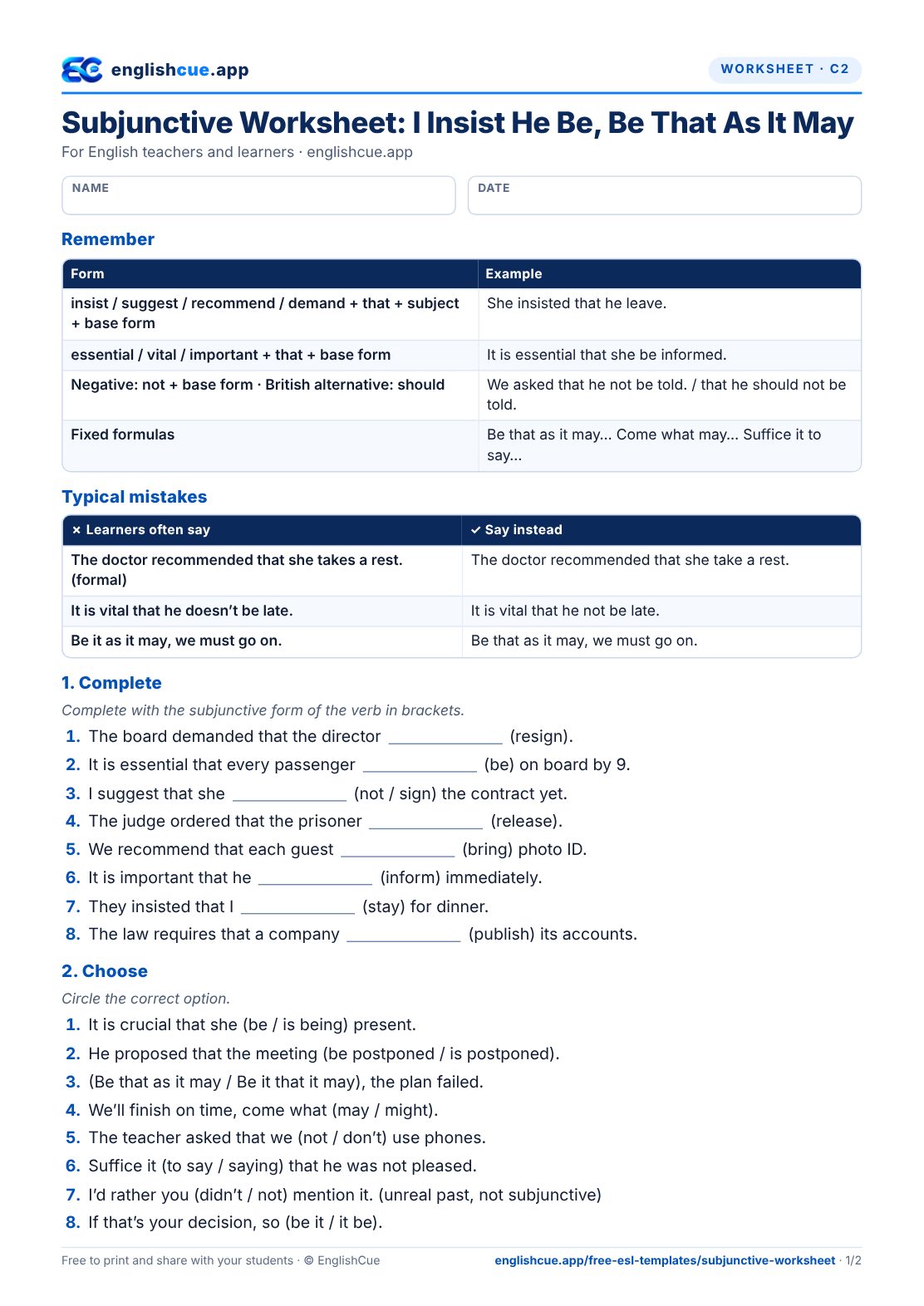 Worksheet · C2 · PDF with answersSubjunctive Worksheet: I Insist He Be, Be That As It May
The forms your learner will use by the end of the lesson.
be that as it may · so be it
Be that as it may, we must decide.
formalcome what may · if need be
Come what may, I’ll be there.
whatever happenssuffice it to say · as it were · be it … or …
Suffice it to say, it failed.
understatementfar be it from me to · heaven forbid
Far be it from me to judge, but…
humour| Formula | Meaning | Example |
|---|---|---|
| be that as it may | even if that is true; however | It’s expensive. Be that as it may, we need it. |
| come what may | whatever happens | Come what may, I’ll finish the marathon. |
| if need be | if necessary | We’ll work at the weekend, if need be. |
| suffice it to say (that) | I won’t give details, but… | Suffice it to say, it was a disaster. |
| as it were | so to speak (metaphor) | He’s the heart of the team, as it were. |
| be it … or … | whether it is … or … | Every job, be it big or small, matters. |
| far be it from me to | I don’t want to (but I will) | Far be it from me to criticise, but… |
| heaven forbid / perish the thought | I really hope not (often ironic) | If, heaven forbid, it rains… |
| so be it / long live / God save | acceptance / celebration | If that’s your decision, so be it. |
These formulas are fixed: don’t change the word order or the verb form (✗ Be it as it may, ✗ Come what will).
The errors students make most often with this structure, and how to explain them.
Rhetorical and polite conditionals: If you’d like to follow me…, If I may say so…, If anything…
Use them as a warm-up or an exit ticket. Answers are below.
All modal verbs and the subjunctive lessons → All C2 grammar lessons →
Share your screen and teach: everything from the warm-up to the writing task is ready.