 ENGLISHCUE
Until 30 November: try EnglishCue PRO for US$0.99 your first week, then US$19.90/month, cancel anytime. Try PRO · US$0.99 →
Worksheet · C2 · For teachers and students · Free PDF, 2 pages
Idiomatic Verb Patterns Worksheet: Can’t Help, Would Sooner
I can’t help thinking he’s right. I would sooner walk than take that bus. The results have yet to be published. You are to report to reception. These idiomatic verb patterns are frequent in educated speech and writing, and each one has its own grammar. This sheet practises the most useful ones, so learners can recognise them in reading and use them with confidence.
Preview
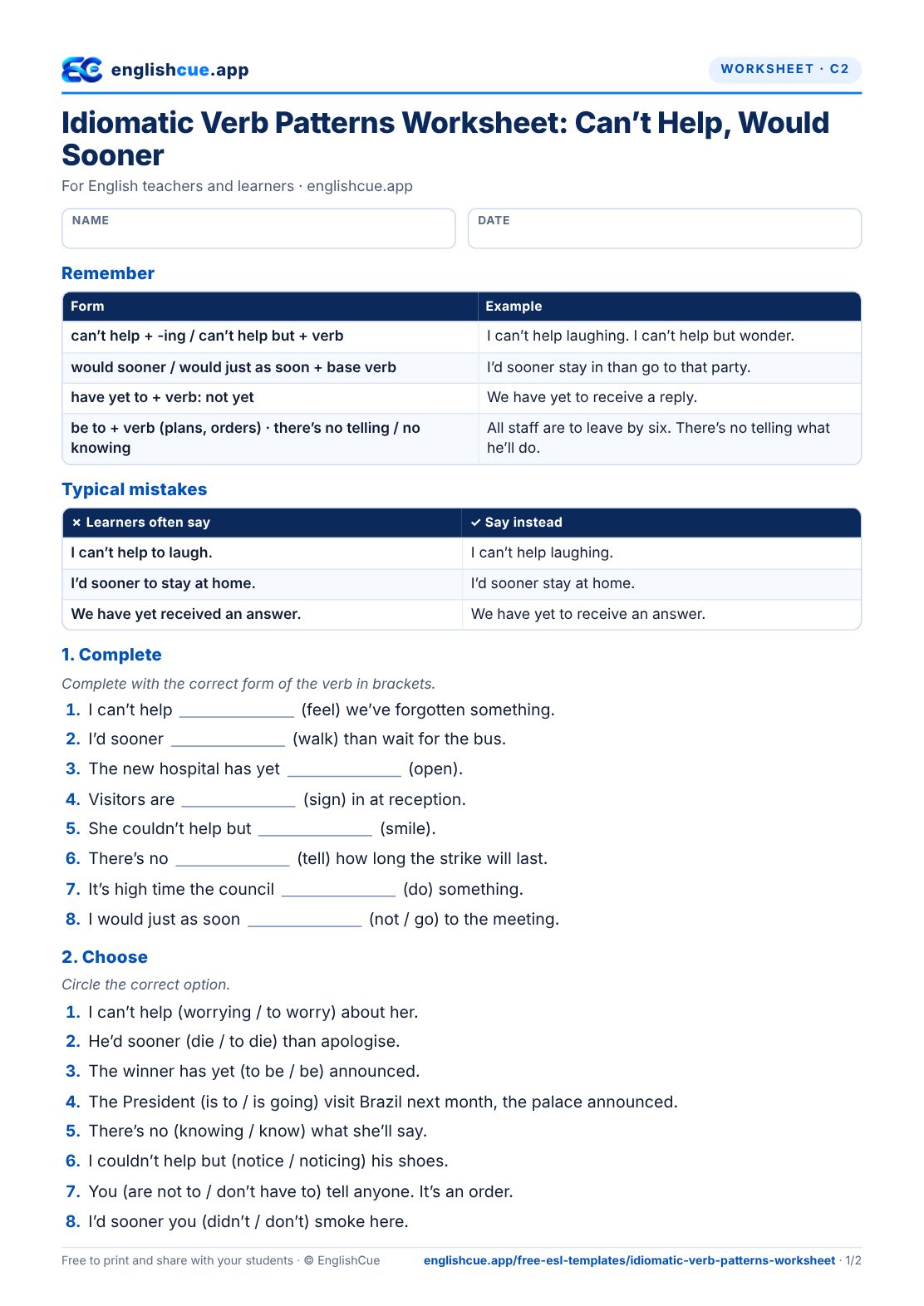
A4, portrait, 2 pages. No sign-up. Free to print, copy and share with your students.
How to use it
- Teach each pattern as a chunk with its grammar attached: can’t help + -ing, would sooner + base verb, have yet to + verb.
- Show the formal ‘be to’ in instructions and news: ‘The Prime Minister is to visit Japan.’
- Give the first page in class or share it on screen; the last page ends with a model answer and the answer key, so print it separately or fold it back.
- Do the speaking questions last and spend at least ten minutes on them: the exercises prepare the language, the conversation is where learners own it.
What is on the sheet
The full content, so you can check it before you print or copy an example onto your own slide.
Remember
| Form | Example |
|---|---|
| can’t help + -ing / can’t help but + verb | I can’t help laughing. I can’t help but wonder. |
| would sooner / would just as soon + base verb | I’d sooner stay in than go to that party. |
| have yet to + verb: not yet | We have yet to receive a reply. |
| be to + verb (plans, orders) · there’s no telling / no knowing | All staff are to leave by six. There’s no telling what he’ll do. |
Typical mistakes
| ✗ Learners often say | ✓ Say instead |
|---|---|
| I can’t help to laugh. | I can’t help laughing. |
| I’d sooner to stay at home. | I’d sooner stay at home. |
| We have yet received an answer. | We have yet to receive an answer. |
1. Complete
Complete with the correct form of the verb in brackets.
- I can’t help ___ (feel) we’ve forgotten something.
- I’d sooner ___ (walk) than wait for the bus.
- The new hospital has yet ___ (open).
- Visitors are ___ (sign) in at reception.
- She couldn’t help but ___ (smile).
- There’s no ___ (tell) how long the strike will last.
- It’s high time the council ___ (do) something.
- I would just as soon ___ (not / go) to the meeting.
2. Choose
Circle the correct option.
- I can’t help (worrying / to worry) about her.
- He’d sooner (die / to die) than apologise.
- The winner has yet (to be / be) announced.
- The President (is to / is going) visit Brazil next month, the palace announced.
- There’s no (knowing / know) what she’ll say.
- I couldn’t help but (notice / noticing) his shoes.
- You (are not to / don’t have to) tell anyone. It’s an order.
- I’d sooner you (didn’t / don’t) smoke here.
3. Correct the mistakes
Each sentence has one mistake. Write it correctly.
- I can’t help to think about it.
- We have yet to receiving the money.
- I’d sooner staying at home.
- There’s no tell what will happen.
- All students are to arriving by eight.
- She couldn’t help but laughing.
Writing
Write a short opinion paragraph (6–7 sentences) about a new technology. Use at least five patterns from this sheet.
Speaking
- What can’t you help doing, even though you know you shouldn’t?
- What would you sooner do than go to a big party?
- What is something you have yet to try?
- Is there a situation in your country where there’s no telling what will happen?
Show the answer key
1. Complete: 1 feeling · 2 walk · 3 to open · 4 to sign · 5 smile · 6 telling · 7 did · 8 not go
2. Choose: 1 worrying · 2 die · 3 to be · 4 is to · 5 knowing · 6 notice · 7 are not to · 8 didn’t
3. Correct the mistakes: 1 I can’t help thinking about it. · 2 We have yet to receive the money. · 3 I’d sooner stay at home. · 4 There’s no telling what will happen. · 5 All students are to arrive by eight. · 6 She couldn’t help but laugh.
Writing, model answer: I can’t help feeling that artificial intelligence is moving faster than our laws. The government has yet to publish clear rules. There’s no telling what these tools will be able to do in five years. Personally, I’d sooner use them for boring tasks than for anything creative. Companies are to report their use of AI from next year, which is a start. Still, I can’t help but wonder who will check those reports. It’s high time we had a serious public debate.
Use it with
More free worksheets
All 100 free worksheets by level, with a PDF pack per level →
Found this useful?
EnglishCue also has complete interactive lessons that open on screen, with audio, practice and speaking tasks.