 ENGLISHCUE
Until 30 November: try EnglishCue PRO for US$0.99 your first week, then US$19.90/month, cancel anytime. Try PRO · US$0.99 →
Worksheet · B1 · For teachers and students · Free PDF, 2 pages
Narrative Tenses Worksheet: Telling Stories in the Past
A good story needs three tenses working together: the past continuous for the background, the past simple for the main events, and the past perfect for what had happened before. This sheet practises choosing between them, uses time linkers like as soon as and by the time, and ends with learners telling a story of their own.
Preview
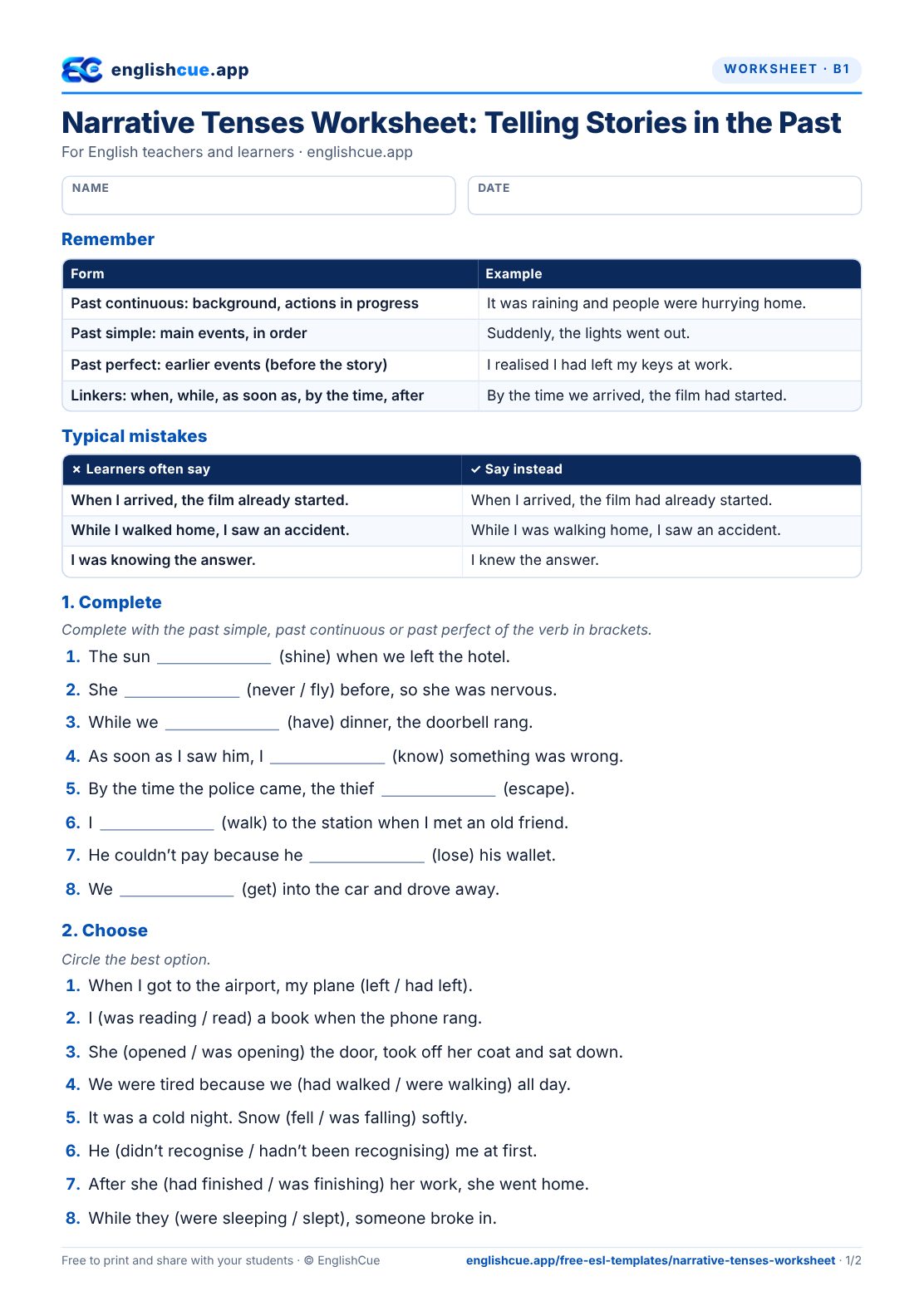
A4, portrait, 2 pages. No sign-up. Free to print, copy and share with your students.
How to use it
- Draw a timeline with three colours, one per tense, for a short story you tell the learner.
- In the speaking task, ask follow-up questions that force each tense: What were you doing? What happened next? What had you done before?
- Give the first page in class or share it on screen; the last page ends with a model answer and the answer key, so print it separately or fold it back.
- Do the speaking questions last and spend at least ten minutes on them: the exercises prepare the language, the conversation is where learners own it.
What is on the sheet
The full content, so you can check it before you print or copy an example onto your own slide.
Remember
| Form | Example |
|---|---|
| Past continuous: background, actions in progress | It was raining and people were hurrying home. |
| Past simple: main events, in order | Suddenly, the lights went out. |
| Past perfect: earlier events (before the story) | I realised I had left my keys at work. |
| Linkers: when, while, as soon as, by the time, after | By the time we arrived, the film had started. |
Typical mistakes
| ✗ Learners often say | ✓ Say instead |
|---|---|
| When I arrived, the film already started. | When I arrived, the film had already started. |
| While I walked home, I saw an accident. | While I was walking home, I saw an accident. |
| I was knowing the answer. | I knew the answer. |
1. Complete
Complete with the past simple, past continuous or past perfect of the verb in brackets.
- The sun ___ (shine) when we left the hotel.
- She ___ (never / fly) before, so she was nervous.
- While we ___ (have) dinner, the doorbell rang.
- As soon as I saw him, I ___ (know) something was wrong.
- By the time the police came, the thief ___ (escape).
- I ___ (walk) to the station when I met an old friend.
- He couldn’t pay because he ___ (lose) his wallet.
- We ___ (get) into the car and drove away.
2. Choose
Circle the best option.
- When I got to the airport, my plane (left / had left).
- I (was reading / read) a book when the phone rang.
- She (opened / was opening) the door, took off her coat and sat down.
- We were tired because we (had walked / were walking) all day.
- It was a cold night. Snow (fell / was falling) softly.
- He (didn’t recognise / hadn’t been recognising) me at first.
- After she (had finished / was finishing) her work, she went home.
- While they (were sleeping / slept), someone broke in.
3. Correct the mistakes
Each sentence has one mistake. Write it correctly.
- When we arrived, everybody went home. (they left before)
- I was cooking when the fire was starting.
- She was tired because she was working since 6 a.m.
- While I watched TV, I heard a noise.
- He had went to bed early.
- By the time I called, she left.
Writing
Write a short story (8 sentences) that begins: ‘It was a quiet evening and I was alone at home…’ Use all three narrative tenses.
Speaking
- Tell me about a time when something went wrong on a trip.
- What were you doing when you heard some important news?
- Describe a moment when you realised you had forgotten something important.
- Tell me the story of how you met a close friend.
Show the answer key
1. Complete: 1 was shining · 2 had never flown · 3 were having · 4 knew · 5 had escaped · 6 was walking · 7 had lost · 8 got
2. Choose: 1 had left · 2 was reading · 3 opened · 4 had walked · 5 was falling · 6 didn’t recognise · 7 had finished · 8 were sleeping
3. Correct the mistakes: 1 When we arrived, everybody had gone home. · 2 I was cooking when the fire started. · 3 She was tired because she had been working / had worked since 6 a.m. · 4 While I was watching TV, I heard a noise. · 5 He had gone to bed early. · 6 By the time I called, she had left.
Writing, model answer: It was a quiet evening and I was alone at home. I was reading on the sofa and the rain was hitting the window. Suddenly, I heard a noise in the kitchen. I went in slowly, but nobody was there. Then I saw that the back door was open. I was sure I had locked it earlier. As I was closing it, a wet cat ran past my feet. It had come in to escape the rain.
Use it with
More free worksheets
All 100 free worksheets by level, with a PDF pack per level →
Found this useful?
EnglishCue also has complete interactive lessons that open on screen, with audio, practice and speaking tasks.